

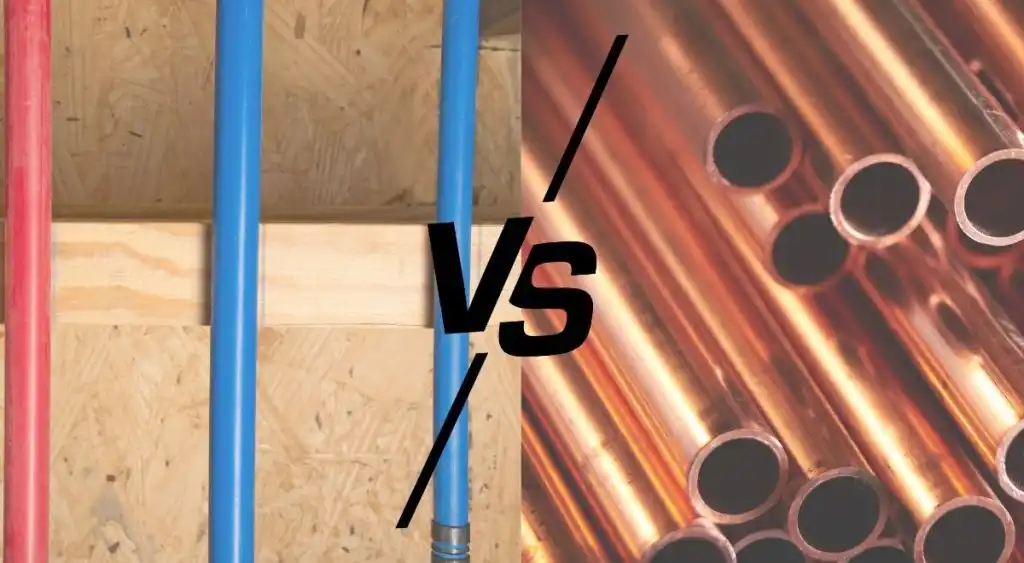
PEX vs copper is the question we get asked on almost every repipe and most renovations. Both are good pipe. Both are approved for drinking water in Ontario. The right one depends on where the pipe is going, what it is replacing, and how the house is built, more than on which material is better in the abstract.
Here is how we weigh it up on a real job in Pickering or Whitby, including the cases where the answer is neither, because the pipe you have is fine.
What each one is
Copper is rigid metal tube. It has been the standard for water supply lines in Canadian houses for most of the last seventy years, and the copper in a well-built 1980s home is often still doing its job. It comes in straight lengths and is cut and joined at every change of direction.
PEX is cross-linked polyethylene, a flexible plastic tube that comes on a coil. It bends around corners, snakes through joists and runs from a central manifold to each fixture in one piece, so a bathroom can be fed with no joints hidden inside the walls at all. Most new houses in Durham Region are plumbed in PEX, and it is what we reach for on the majority of repipes.
How they are joined
Copper is soldered. The fitting and the pipe are cleaned, fluxed and heated with a torch until the solder is drawn into the joint. Done properly, a soldered joint is as strong as the pipe. Done badly, it weeps, and there is an open flame inside your wall while it is being done. Press fittings that crimp onto copper without heat exist too, and we use them where a torch is a bad idea, such as near old framing or insulation.
PEX is joined with crimp rings, clamp rings or expansion fittings, all cold. No flame, no flux, and a joint takes seconds. The trade-off is that the fittings sit inside the pipe and slightly narrow it, which matters on long runs and small sizes, and that the quality of the joint depends entirely on the tool being calibrated and the person using it checking every ring.
Ontario winters: freezing
This is the difference that matters most around here.
Water expands when it freezes. Copper does not give, so a frozen copper line splits, usually along the pipe or at a joint, and you find out when it thaws and the water starts moving again. We cover what to do in those first minutes in our guide to frozen and burst pipes.
PEX stretches. A frozen PEX line swells and in most cases returns to shape when it thaws, without splitting. That is not a licence to leave it in an unheated garage wall, because the fittings do not stretch and the pipe can still fail after repeated freezes. But for a run through an exterior wall, a crawl space or a cold corner of a basement, PEX gives you a margin that copper does not.
Corrosion and pinhole leaks
Copper corrodes from the inside over time. Pinhole leaks are the usual result: a drip you cannot see, in a wall or a ceiling, that shows up as a stain two rooms away. Hard water, acidic water, stray electrical current and turbulence at badly fitted joints all speed it up. In the older streets of Pickering south of the 401 and around downtown Whitby, pinholes in copper are one of the more common calls we get for leak detection and pipe repair.
PEX does not corrode and does not scale up inside the way metal does. It has its own weak points, which is only fair to say.
What PEX does not like
Sunlight. PEX breaks down with UV exposure, so it should never be run outdoors or past a basement window without protection, and it should not sit on a job site in the sun for weeks before it goes in.
Rodents. Mice and squirrels will chew PEX. In a tidy, finished house that is rarely a problem. In a garage, a shed, a cottage or an older home with a known rodent issue, it is worth talking about before the pipe goes in, because copper is simply not on their menu.
Heat. PEX cannot be connected directly to a water heater. The first stretch off the tank is done in copper or another rated material, then transitions to PEX. Any plumber doing it properly knows this, but it is a common find on do-it-yourself work.
How long each lasts
Both are expected to last decades when they are installed properly and the water is not unusually aggressive. The copper that fails early in our area is usually old, thin-walled, or running water that has been eating it from the inside for a long time. The PEX that fails early is almost always a fitting problem or something it was never meant to be exposed to.
We would rather not give you a number of years for either. Manufacturers publish their own figures, and the real answer in any one house depends on the water, the installation and the conditions in the wall.
PEX and copper at a glance
| PEX | Copper | |
|---|---|---|
| Joining | Crimp, clamp or expansion, no flame | Soldered with a torch, or press fittings |
| If it freezes | Usually stretches and recovers; fittings can still fail | Splits |
| Corrosion | None | Pinhole leaks over time, faster with hard or acidic water |
| Weak points | Sunlight, rodents, direct heat | Freezing, water chemistry, bad joints |
| Best for | Repipes, renovations, rough-ins, cold runs | Exposed runs, near heat, outdoors, matching existing copper |
| Cost | Generally lower material and labour | Generally higher material and labour |
Where copper still makes sense
Exposed runs where appearance matters, such as a finished basement bar or a mechanical room you want to look tidy. Anywhere near high heat. Outdoor hose bibs and the first run off a water heater. Houses where the owner has a rodent history and does not want to think about it again. And repairs to an existing copper system where it is cleaner to match the material than to add transition fittings every few feet.
Where PEX makes sense
Most repipes. When the original supply pipe is galvanised steel, which is still common in the oldest Pickering homes and has corroded until the pressure is a trickle, PEX lets us run new lines through the existing structure with far fewer openings in the walls. Fewer holes to patch is most of the saving on a repipe.
Renovations. When a kitchen or bathroom is opened up and the layout is changing, PEX is quick to route and easy to adjust, and it suits the way we do renovation plumbing in Pickering: lines moved, capped and left ready before the drywall goes on.
Basement rough-ins. A new bathroom under the house means supply lines snaking between joists and across the ceiling. PEX does that in long continuous runs. More on how that work is planned on our basement plumbing rough-ins page.
The polybutylene houses
A good share of the homes built across Pickering, Ajax and Whitby in the 1980s and early 1990s were plumbed with polybutylene, a grey plastic pipe that was popular, cheap and later found to fail at the fittings. If your house is from that era and the supply lines behind the walls are grey, that is probably what you have.
Polybutylene pipe replacement is the most common full repipe we do. PEX is the natural replacement because it follows the same paths the polybutylene took, so the walls that have to be opened are mostly the ones with fittings in them. Our Whitby plumbing work in particular turns this up often in the subdivisions north of Dundas.
Cost, in general terms
PEX material is generally the lower cost of the two, and the labour is usually lower as well because the runs are faster and there are fewer joints and fewer wall openings. Copper takes longer to install and the material has become expensive. Those are the general directions. We do not publish figures here because every repipe is quoted on the house: how many fixtures, how the walls are finished, whether the basement ceiling is open, and whether the main shut-off and the line from the street need doing at the same time.
When a partial repipe is enough
It is not always the whole house. If one copper line has pinholed and the rest of the system tests sound, replacing that run is the sensible job. If the galvanised is only on the main and the branches were replaced in copper years ago, the main is the job. If a polybutylene house has already had its bathroom repiped during a renovation, the kitchen and the basement may be all that is left.
What we will not do is replace a single fitting and send you a bill for a leak that is going to come back on the next fitting along. When the material itself is the problem, we say so. When it is one bad joint, we say that too.
Who should do the work
Plumbing is a compulsory trade in Ontario. Anyone running new supply lines in your house must hold a Certificate of Qualification or be a registered apprentice, and they are listed on the Skilled Trades Ontario public register where you can look them up. Agshin Yusifov, who runs the jobs at AY Plumbing and Renovation Service, is on that register. Any repipe that is tied to a permit, which a full repipe often is, will be inspected by the municipality.
Not sure which you have?
Look where the supply line comes into the house, usually near the water meter in the basement. Copper is dull orange metal. Galvanised steel is grey metal with threaded joints. Polybutylene is grey plastic, usually with copper or plastic crimp fittings. PEX is most often red, blue or white plastic.
If a line is leaking, the pressure has been dropping for months, or you have found grey plastic behind a wall you opened, call 647-248-7755. We will tell you what you have, what is worth replacing, and what can stay. Full details on our leak detection and pipe repair page.