
Most burst pipes in an Ontario winter do not happen in the middle of the house. They happen in the same handful of places every year: a pipe running along an outside wall, a line through an unheated garage, the tap on the back of the house that nobody shut off in the fall, a crawlspace with a gap in the insulation.
That is good news, because it means the problem is predictable. If you know where your pipes are exposed, you can deal with most of the risk before the first hard frost.
Why a frozen pipe bursts
People assume the ice splits the pipe at the frozen spot. Usually it does not.
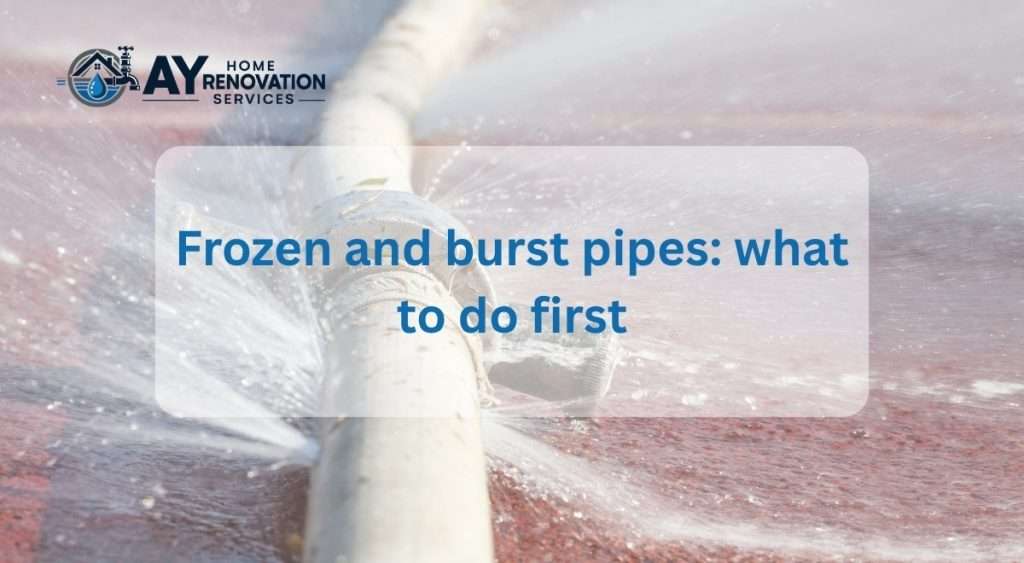
When water freezes inside a pipe, the ice plug expands and pushes the remaining water ahead of it towards the nearest closed tap. That trapped water has nowhere to go, the pressure climbs, and the pipe gives way at its weakest point, which is often somewhere between the ice and the tap rather than where the ice is. That is why a burst can turn up in a spot that never looked cold.
It is also why a burst often goes unnoticed until the thaw. While the line is frozen solid, nothing leaks. When it warms up and the water starts moving again, the split opens and the water comes out at full mains pressure.
Where pipes freeze
Check these before the cold arrives:
- Outside taps (hose bibs). The most common culprit. A hose left connected over winter stops the tap from draining and makes it far more likely to freeze.
- Pipes on exterior walls, especially under kitchen sinks on an outside wall, where the cabinet keeps the warm room air away from the pipe.
- Unheated spaces: garages, crawlspaces, attics, and unfinished corners of a basement near the rim joist.
- Lines near gaps, where a dryer vent, cable entry or old window lets cold air blow straight onto a pipe. A small draft does more damage than a cold room.
- Additions and renovated areas, where plumbing sometimes ends up in a wall that was never meant to hold it.
How to stop it happening
None of this is expensive, and most of it takes an afternoon.
Shut off and drain the outside taps. Find the shut-off valve for each one inside the house, close it, then open the outside tap to let the line empty. Leave the outside tap open over winter. Disconnect and store the hose. If your outside taps are the frost-free type, the hose still has to come off, or the tap cannot drain.
Insulate exposed pipes. Foam pipe sleeves from any hardware store are cheap and quick to fit. Cover the pipes in the garage, crawlspace and any basement run close to an outside wall.
Seal the drafts. Caulk or foam the gaps where cold air gets in near pipes. This is often worth more than the insulation.
Keep the heat steady. Do not drop the thermostat too far at night or when you go away. A house that is cold for a long weekend in January is how pipes freeze in homes that never had a problem before. If you are away for more than a few days in winter, ask someone to check the house.
Open the cabinet doors under sinks on outside walls during a cold snap, so room heat reaches the pipes.
Let a tap drip on the coldest nights if you have a pipe that has frozen before. Moving water is much harder to freeze, and a slow drip also relieves the pressure that causes the burst.
Signs a pipe is already frozen
- You turn on a tap and get nothing, or only a trickle, while other taps work.
- Frost on a visible section of pipe.
- A toilet that will not refill.
- A bulge or a hairline crack in an exposed pipe.
- An unusual smell from a drain, which can mean the drain line is blocked by ice.
If one tap stops working on a very cold morning, assume a frozen line until you know otherwise, and treat it as urgent.
How to thaw a frozen pipe safely
If you can see the frozen section and there is no sign of a split, you can often thaw it yourself.
- Open the tap it feeds, both hot and cold. This gives the melting water somewhere to go and relieves the pressure.
- Work from the tap end back towards the frozen section, so the meltwater drains as it goes.
- Use gentle heat: a hair dryer, a space heater kept well clear of anything that can burn, or towels soaked in hot water wrapped around the pipe.
- Keep the heat on until full flow returns, then check the whole run for leaks.
What not to do: never use a propane torch, a blowtorch or any open flame. It can damage the pipe, it can set fire to the framing behind it, and it is one of the more common ways a frozen pipe turns into a house fire. Do not use anything electrical if there is standing water nearby.
If the frozen section is inside a wall or ceiling, or you cannot find it, call a plumber rather than guessing. Heat applied in the wrong place does nothing, and opening up a wall to search is a bigger job than it needs to be.
If a pipe has burst: the first five things to do
Water at mains pressure comes out fast. These steps, in this order, limit the damage.
- Shut off the main water valve. It is usually in the basement where the water line comes into the house, often near the water meter. Find it now, before you ever need it, and make sure it turns.
- Turn off electricity to the affected area if water is near outlets, a panel or appliances, and only if you can reach the breaker without standing in water.
- Open the taps on the lowest floor to drain what is left in the pipes.
- Call a plumber. We answer around the clock, including nights and weekends, on 647-248-7755. Burst pipes do not wait for working hours, and neither do we. You can read more about our leak and pipe repair service.
- Photograph everything before you start cleaning up: the burst, the water, the damaged contents. Your insurer will want to see it.
Then move what you can out of the water, and start drying the area as soon as it is safe. Water left standing in drywall and flooring is what turns a pipe repair into a mould problem.
When it is a job for a plumber
Some of this is genuinely DIY. A frozen pipe you can see and reach, with no split, is something most homeowners can handle with a hair dryer and patience.
These are not:
- any pipe that has split or is leaking
- a frozen section you cannot locate, or one inside a wall or ceiling
- repeat freezing in the same spot, which usually means the pipe needs rerouting or proper insulation rather than another thaw
- a frozen drain line or main line
A burst pipe belongs on the list of emergency plumbing problems you should never ignore. The longer the water runs, the more expensive the repair becomes, and the repair to the pipe itself is usually the smallest part of the bill.
Getting ahead of it
The best time to deal with frozen pipes is October, not January. Walk the house once: the outside taps, the garage, the crawlspace, the cabinets on outside walls. Find your main shut-off and make sure it moves. If you find a pipe that has frozen before, fix the reason it froze rather than hoping this winter is milder.
If you would rather have someone look at the risky spots before winter, our experienced team covers Pickering and the rest of Durham Region, and we can tell you which pipes need attention and which are fine as they are.