
Tankless water heaters get sold on the idea that they’re simpler than a tank. No stored water, no standby losses, no forty-gallon cylinder waiting to fail in your basement.
All true. But simpler doesn’t mean maintenance-free, and this is where a lot of owners get caught out. A tank heater that’s never serviced will limp along for a decade before it gives up. A tankless unit that’s never descaled can start throwing errors in three or four years.
That difference is worth understanding before you buy, and it sits inside the wider comparison between tankless and tank heaters.
The good news is that the maintenance is predictable, and if you stay ahead of it these units last a long time.
What’s actually happening inside
A tankless heater works by running water through a heat exchanger, a coiled path surrounded by burners or elements that heat the water as it passes.
That path is narrow. It has to be, because the water only has a moment to absorb enough heat.
Every litre that passes through carries dissolved minerals, and at the temperatures inside that exchanger, some of those minerals deposit on the walls. The coating builds slowly and evenly, and because the channel is narrow to begin with, it doesn’t take much scale to matter.
Two things happen as it thickens. Flow through the exchanger drops. And the scale insulates the water from the heat source, so the unit fires harder and longer to hit its target temperature.
This is the same chemistry as sediment in a tank heater, and the yearly maintenance a tank needs exists for the same reason. The difference is the consequence. In a tank, sediment settles harmlessly at the bottom for years. In a tankless unit, scale forms directly on the surface doing the work, in a passage narrow enough that a millimetre of buildup changes performance.
How often
The usual guidance is once a year.
Harder water pushes that to every six to eight months. Genuinely soft water, or a house with a working water softener ahead of the heater, can stretch it further.
Manufacturers publish their own intervals and often tie warranty coverage to them, which is worth knowing before you skip a year. Some units log their own runtime and flag a service reminder.
If you’ve moved into a house with an existing tankless heater and have no idea when it was last done, assume it’s due.
The signs it’s overdue
A tankless heater tells you it’s scaling up, but the signals are easy to explain away.
Temperature that wanders. You set 49°C and get water that drifts warmer and cooler through a shower. Restricted flow through a fouled exchanger makes it harder for the unit to hold a steady output.
The cold water sandwich, getting worse. A brief cold slug when you restart a tap shortly after using one is normal on most tankless units. If it’s lasting noticeably longer than it used to, that’s a change worth noting.
Flow that’s dropped off. If a shower that used to be strong has gone weak and nothing else in the house has changed, scale in the exchanger is a candidate.
Error codes. Most units report faults as numbered codes. Some map to ignition or venting problems, but several relate directly to scale, flow restriction or overheating. Look yours up rather than clearing it and carrying on. A code that keeps returning is telling you something.
Longer to get hot. A gradual increase in the time between opening the tap and getting hot water at the fixture.
None of these are dramatic. That’s the difficulty. They arrive slowly enough that you adjust to them, and the unit that “was always a bit like that” turns out to have been fine two years ago.
What descaling involves
Descaling means circulating a mild acidic solution through the heat exchanger to dissolve the mineral deposits.
The outline:
- Power down the unit and shut the gas.
- Close the hot and cold isolation valves.
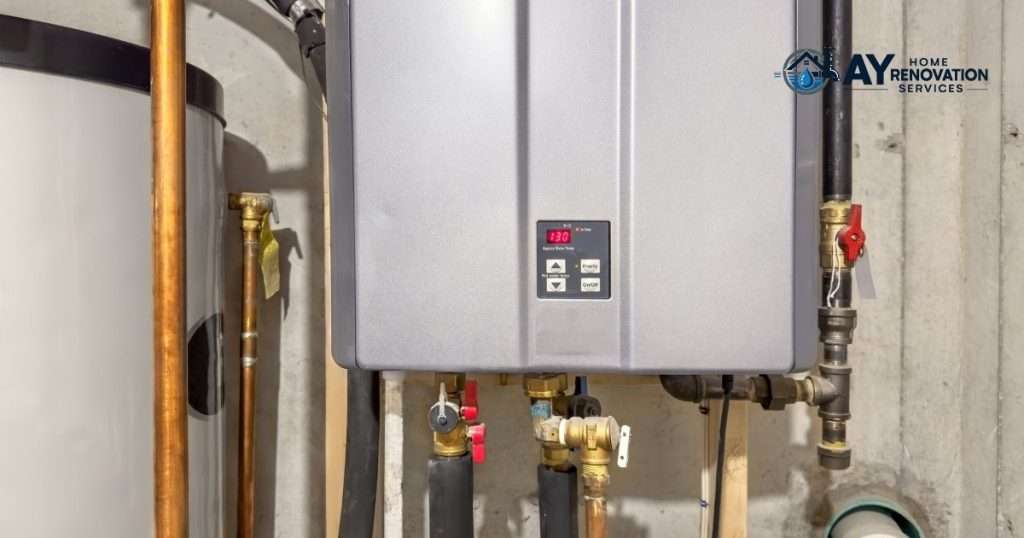
- Connect hoses to the service ports. Most units have a pair fitted for exactly this.
- Pump a descaling solution, usually food-grade white vinegar or a proprietary product, in a closed loop through the exchanger with a small submersible pump and a bucket.
- Circulate for roughly 45 minutes to an hour.
- Flush thoroughly with clean water to clear all traces of the solution.
- Clean the inlet water filter screen, which catches grit and is often overlooked.
- Reopen the valves, restore gas and power, check operation.
While the unit is open, the air intake filter is worth cleaning too, and on a condensing model the condensate trap and neutraliser should be checked. Those take minutes and are easy to forget entirely.
Can you do this yourself?
More realistically than an anode rod on a tank heater, yes, if two conditions are met.
Your unit has isolation valves with service ports. These are a matched pair of valves installed on the hot and cold lines, each with a hose connection. If yours were fitted, descaling is a straightforward job with a pump, a bucket and a couple of hoses.
If they weren’t, the job means breaking into the plumbing to fit them. At that point it’s plumbing work rather than maintenance, and it is worth folding into a water heater service visit.
You’re comfortable isolating the gas and power. Nothing about the descaling itself is dangerous, but you’re working on a gas appliance. If that gives you pause, that instinct is worth listening to.
A fair number of tankless installs skip the service valves to save on the initial cost, which quietly makes every future service more expensive. If you’re having a tankless unit installed, ask specifically whether they’re included. It’s a small addition at install and a considerable nuisance later.
What it costs you to skip it
Scale doesn’t clear itself. It accumulates, and past a certain point it stops being something a descaling flush can fully reverse.
The progression is roughly: efficiency drops and your gas use rises; temperature control gets erratic; the unit starts throwing flow or overheat codes; and eventually the exchanger is damaged enough to need replacing. On most units, a heat exchanger is a significant proportion of the cost of the whole appliance.
Set against that, an annual service is inexpensive insurance. It’s the same argument as changing the oil in a car, and it fails the same way when ignored. Slowly, then all at once.
There’s a warranty dimension too. Manufacturers commonly require documented maintenance, and a scale-related failure on a unit that’s never been serviced is a straightforward claim denial.
Water softeners
If your water is hard, a softener ahead of the heater reduces scale formation substantially and extends the descaling interval.
Whether that’s worth it depends on your water and your household. Softeners have their own maintenance, running cost and space requirements, and they affect the whole house rather than just the heater. It’s a bigger decision than a maintenance item, but if you’re descaling twice a year and finding heavy scale each time, it’s the right question to ask.
The short version
Once a year, descale it. Clean the inlet filter while you’re there. Look up any error code rather than clearing it. Note whether your unit has service valves, because that single detail decides whether this is a routine job or a plumbing call.
Tankless heaters reward this kind of attention. They’re built to run a long time, and the ones that do are almost always the ones that got serviced.
If your unit is throwing codes, running unevenly, or hasn’t been touched since it was installed, we service tankless heaters across Ajax, Whitby and Durham Region. The full range of our plumbing work in Pickering is worth a look if you are weighing up a replacement. Call 647-248-7755, any hour.