

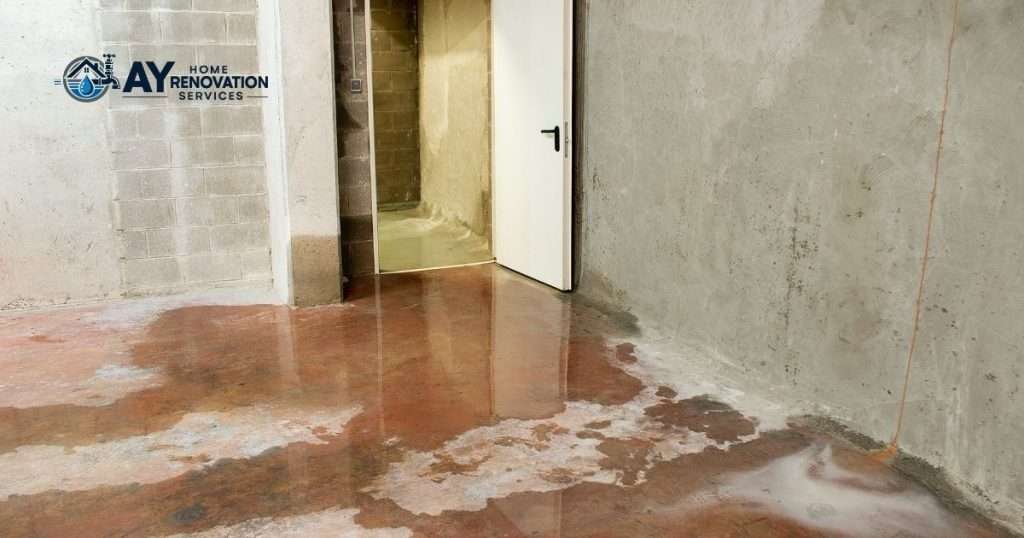
A sewer smell in a basement sits in an awkward place. Most of the time it is something trivial that takes five minutes to fix. Occasionally it is the first warning of a problem that ends with sewage on the floor.
The difference matters, and the two are not hard to tell apart once you know what to look at.
Basements are also where this happens most often, for reasons worth understanding. The main drain runs beneath the basement floor. The floor drain is frequently the lowest opening in the entire system. And basements are the least used rooms in most houses, which turns out to be the single biggest factor.
Start with the floor drain
If your basement has a floor drain, and most in this region do, that is the first place to look and it explains this smell more often than everything else combined.
The floor drain has a trap under it, the same U-shaped bend that sits under a sink. It holds water, and that water is the only thing standing between the room and the sewer line.
Nobody pours water down a floor drain. It gets used when the washing machine empties, if the washing machine drains there, and otherwise never. Over weeks, the water in that trap evaporates. Winter heating dries the air out and accelerates it considerably. Once the trap is empty the drain is an open pipe to the sewer, and the smell arrives.
Pour a bucket of water down it. If the smell fades over the next hour, that was the cause and you are finished.
To stop it recurring, do the same thing every couple of months. Adding a small amount of cooking oil after the water slows evaporation, which is worth doing for a drain nobody thinks about from one year to the next.
Some floor drains have a trap primer, a small line that feeds them automatically. If yours has one and the trap is still drying out, the primer has failed and that is worth mentioning to whoever next looks at your plumbing.
The other easy one: an unused bathroom
Basement bathrooms, laundry sinks and floor-level shower stalls all dry out the same way for the same reason. If your basement has a fixture nobody uses, run it. The same rule applies.
We covered the full set of dry trap and drain causes in more detail in why a bathroom smells like sewer, and everything in that piece applies to a basement bathroom too.
Now the part that is not trivial
If you have poured water into every trap in the basement and the smell is still there, the diagnosis changes. You are no longer looking at evaporation. You are looking at the main line.
Three things to check for, and any one of them is a reason to have it looked at properly.
The smell is worse after heavy rain. This is the signal that matters most in this region. Rain should not affect a sanitary drain. If it does, water is getting into the line where it should not, or the line is struggling to clear. Both point at a problem in the main drain.
The floor drain gurgles, or water rises in it. A floor drain that burps when a toilet flushes upstairs, or that shows water welling up and receding, is telling you the main line is restricted. The system is having to push air past an obstruction.
The smell arrives with slow drains elsewhere in the house. If the basement smell coincides with the ground floor draining sluggishly, the common factor is the main line rather than any individual fixture.
Those three together are the classic picture of a main drain that is partially blocked, by roots, by grease, by a collapsed section, or by a joint that has shifted. It does not clear itself and it does not stay at the same severity. A partial blockage becomes a full one, usually at an inconvenient moment.
That is the point at which drain cleaning on the main line is worth doing before the situation escalates, rather than after.
The backwater valve question
Anyone dealing with basement drain problems in Durham Region ends up at this question eventually, so it is worth covering properly.
A backwater valve is a one-way gate fitted into the main drain. Water and waste leave the house normally. If the municipal sewer surcharges during heavy rain and tries to push back toward the house, the valve closes and the basement stays dry.
Basements in Pickering and the surrounding Durham Region are exposed to this in a way that is easy to underestimate. Older neighbourhoods have older sewer infrastructure, storm events have become less predictable, and a surcharged sewer does not care how tidy your own plumbing is. The water comes back up the lowest opening in your house, which is almost always the basement floor drain.
A sewer smell that appears during or after heavy rain is worth taking seriously in that context. It can mean the line is already under pressure at those times. It does not prove a backup is coming, but it is exactly the pattern that precedes one.
A note on funding. Durham Region operates a programme relating to backwater valves for residential properties. Details, eligibility and the form the assistance takes are worth confirming directly with the Region rather than relying on second-hand descriptions, because published accounts of it are frequently wrong about what is actually on offer. We are not going to summarise terms here that we have not verified.
If your basement has a history of taking water, or the smell follows the weather, backwater valve installation is the conversation worth having.
What a sewer smell is, and how worried to be
The smell is sewer gas, which is a mixture rather than a single thing. Hydrogen sulphide is the component responsible for the rotten egg character, along with methane, ammonia and others.
Two honest points about the risk.
At the concentrations produced by a dry trap in a ventilated basement, it is unpleasant rather than dangerous. People live with this for months without harm. There is no need to evacuate the house over a smelly floor drain.
At high concentrations in an enclosed space, sewer gas genuinely is hazardous, and one of its more unpleasant properties is that it deadens the sense of smell, so a strong exposure can seem to fade. That is why a heavy, persistent smell in a closed basement is a reason to open windows and ventilate rather than to get used to it.
The practical position is that you should not panic and you should not ignore it either.
A short diagnostic
Work through this in order and you will usually land on the answer.
- Pour water into every floor drain and run every basement fixture. Wait an hour. If the smell clears, it was evaporation. Done.
- Check whether it tracks the weather. Note whether the smell is worse during or after heavy rain. That single observation separates a nuisance from a warning.
- Listen when other fixtures drain. Gurgling from the floor drain when a toilet flushes upstairs points at the main line.
- Check for anything visible. Damp around the floor drain, staining on the floor, or a tide mark on stored boxes suggests the drain has backed up before, possibly without anyone noticing.
- Ask how old the house is and whether it has flooded before. Previous basement water changes the calculation on a backwater valve considerably.
The short version
Most basement sewer smells are a dry floor drain trap and a bucket of water fixes them permanently, provided you remember to do it again in a couple of months.
The ones that matter announce themselves clearly: they follow heavy rain, they come with gurgling, or they arrive alongside slow drains elsewhere. Those are main line symptoms, and a main line problem is one of the few plumbing faults where the eventual failure mode is genuinely expensive.
If you have poured the water and the smell is still there, or it gets worse when it rains, we handle drain and main line work across Pickering, Ajax and Whitby. Call 647-248-7755, any hour.