

A bathroom that smells of sewer is one of those problems people put up with far longer than they should, usually because it comes and goes. It is bad on Monday, gone by Wednesday, back on Saturday. That intermittence makes it easy to write off.
It is worth taking seriously, for two reasons. The smell is sewer gas, which is not something you want circulating in the house. And the intermittence is itself a clue, because the causes that come and go are different from the causes that never let up.
Here are the six things it usually turns out to be, roughly in order of how often we find them, and how to work out which one you have.
First, the thing that tells you most
Before working through the list, notice when you smell it.
If the smell appears after the room has been unused for a while, and clears once you run the water, you are almost certainly looking at a dry trap. That is the first cause below and it is the most common by a wide margin.
If the smell is constant regardless of use, it is more likely a seal or a vent problem.
If it is worse when other fixtures in the house are draining, that points hard at venting.
That one observation will usually cut the list from six to two.
1. A dry P-trap
Under every fixture there is a U-shaped bend of pipe. That is the P-trap, and its entire purpose is to hold a small amount of water permanently, forming a plug that sewer gas cannot pass through.
If the water in that trap evaporates, the plug is gone and the drain becomes an open pipe to the sewer.
This is why guest bathrooms, basement floor drains and rarely used shower stalls are the usual suspects. Water evaporates over weeks of no use. Dry air in winter speeds it up considerably.
The fix is to run the tap. Thirty seconds is enough to refill the trap. If the smell disappears, you have found it.
For a fixture you genuinely never use, run it once a month. For a basement floor drain, which is the one people forget entirely, pour a jug of water down it every few weeks. Adding a small amount of cooking oil on top slows evaporation, which is worth doing for a drain that only gets attention twice a year.
2. Buildup in the drain itself
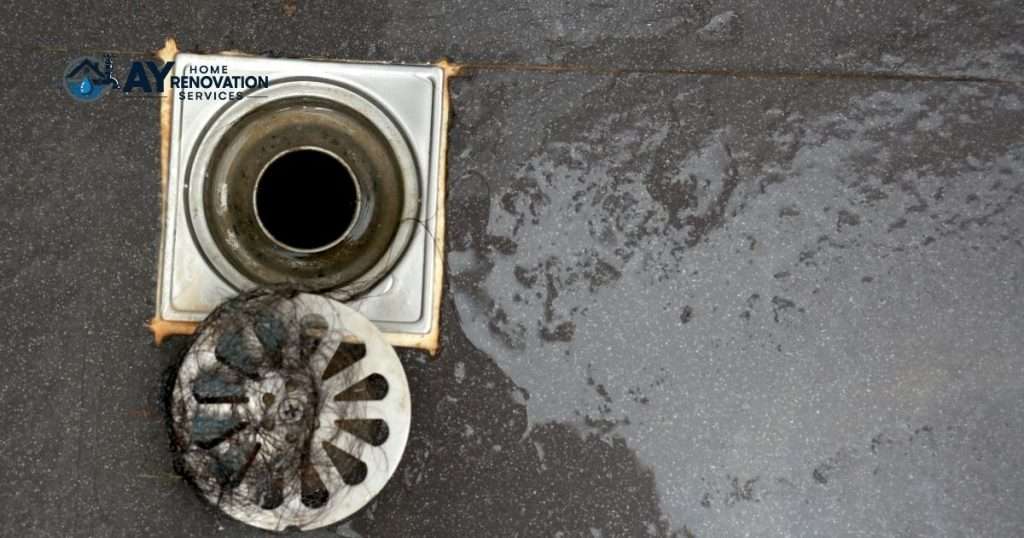
Hair, soap, skin cells and toothpaste form a layer on the inside of the drain pipe, particularly just below the plughole. Bacteria grow in it. That is what produces the smell.
This one has a distinctive character. It tends to be a stale, sour, slightly organic smell rather than the sharper gas smell of an empty trap, and it is usually strongest right at the plughole rather than filling the room.
Test it by putting your nose close to the drain opening. If the smell is clearly coming from the hole itself and is much weaker a foot away, this is your cause.
Cleaning the visible part helps. Take out the stopper, which usually lifts or twists free, and clean it along with as much of the pipe as you can reach. It is unpleasant work and it is usually the answer.
If the smell persists after cleaning everything you can get to, the buildup runs further down the pipe than a brush will reach, and that is the point where a proper drain clean is worth more than another go with a cloth.
A word of warning on what to clean it with: reach for hot water, a brush, and time rather than a bottle of chemical drain opener. We have written separately about what chemical drain cleaners actually do to pipes, and for a smell rather than a blockage they are the wrong tool entirely.
3. A failed toilet wax seal
Where the toilet meets the floor there is a seal, traditionally a wax ring, that closes the gap between the toilet base and the drain opening beneath it.
When that seal fails, sewer gas escapes around the base of the toilet.
Two signs point here. The smell is strongest at floor level near the toilet rather than at the sink or shower. And the toilet may rock slightly when you shift your weight on it, because movement is what breaks these seals in the first place.
Sometimes there is also a faint water stain on the floor around the base, or the flooring feels soft. That is a more serious version of the same fault, and it means water has been getting under there as well as gas.
Replacing a wax seal means lifting the toilet off. It is a well-defined job but it is not a five minute one, and putting a toilet back down badly creates a leak you will not see until the ceiling below it stains.
4. A blocked or restricted vent
Your drains are connected to a vent pipe that runs up through the roof. It exists to let air into the system so water can flow.
Without it, a draining fixture creates suction behind itself, and that suction pulls the water out of nearby P-traps. The trap empties, and the gas plug is gone.
The signature is very specific and worth knowing:
- Gurgling from one drain when a different fixture drains
- The smell appears right after the washing machine empties, or after someone runs a bath
- A toilet whose water level visibly rises and falls without anyone touching it
If you are seeing those, the smell is a symptom and the vent is the fault. Fixing the trap will not solve anything because it will just empty again.
Vents get blocked by leaves, nests and in this climate by ice at the roof outlet during a hard freeze. Occasionally they were never installed correctly in the first place, which shows up in bathrooms added later or basement bathrooms put in during a renovation.
This one is a stop and call someone problem. It is roof work and drain layout work, not a homeowner job.
5. A cracked or disconnected pipe
Less common, more serious. A drain pipe inside a wall or under the floor has cracked, or a joint has separated. Gas escapes into the wall cavity and then into the room.
Suspect this when the smell is constant, does not respond to running water, is not localised to one fixture, and seems to come from the wall rather than a drain.
You may also see staining on the wall or ceiling, or hear water where there should not be any. This needs someone to locate the fault properly rather than guess at which wall to open.
6. The problem is not in the bathroom
Worth mentioning because it wastes a lot of people’s time.
If the smell is present in the bathroom but also faintly elsewhere, particularly in a basement, the source may be a main line issue rather than anything in that room. A partial blockage in the main drain, or a missing or failed backwater valve, produces smells that turn up wherever the gas can find a way in.
We have covered that separately in what a sewer smell in the basement means, because it is a different problem with different consequences.
What to do, in order
- Run every tap and flush every toilet in the room, then wait an hour. If the smell goes, it was a dry trap.
- Put your nose right at each drain opening. If one is obviously the source, clean the stopper and the pipe below it.
- Stand next to the toilet and smell at floor level. Rock the toilet gently. If it moves, suspect the seal.
- Run the bath or the washing machine and listen. Gurgling elsewhere means a vent problem.
- If none of that identifies it, or the smell is constant and seems to come from a wall, stop guessing.
Most bathroom sewer smells are one of the first two causes and cost nothing to fix. The remaining ones are genuinely worth having looked at, because a vent fault, a failed seal and a cracked pipe all get worse and all cause damage beyond the smell.
If you have worked through the list and it is still there, or you heard gurgling and would rather not go up on the roof, we handle drain cleaning and drain repairs across Pickering, Ajax and Whitby. Call 647-248-7755, any hour.