
When a water heater fails, most people replace it with the same thing they had. It’s the path of least resistance, and often it’s the right call.
But it’s worth at least asking the question, because the two options behave quite differently in daily use, and the one that suits a two-person household is not necessarily the one that suits a family of five with two bathrooms.
Here’s an honest comparison, including the parts that tend to get skipped in sales conversations.
How each one works
A tank heater keeps thirty to sixty gallons of water hot around the clock. When you open a tap, hot water leaves the top of the tank and cold water enters the bottom to replace it. A burner or element fires periodically to hold the stored water at temperature.
A tankless heater stores nothing. When you open a hot tap, a flow sensor detects the demand and fires the burner. Water passes through a heat exchanger and comes out hot. When you close the tap, it shuts off.
That difference drives everything else.
Hot water supply
This is where the two diverge most obviously, and where most disappointment comes from.
A tank gives you a fixed quantity of hot water at full strength, and then it’s gone. Empty a forty-gallon tank and you’re waiting for recovery, which takes a while on a gas unit and considerably longer on electric. Run a bath, then a shower, and the second person finds out.
A tankless unit never runs out. What it has instead is a flow limit. It can only heat so many litres per minute to a given temperature, and if demand exceeds that, everything slows or cools rather than stopping.
The practical distinction is that a tank fails on duration and a tankless fails on simultaneous demand.
If your household’s problem is the fourth shower of the morning going cold, tankless solves it. If your problem is two showers and the dishwasher at once, tankless may not, unless it’s sized properly for that load.
And sizing is where Ontario’s climate matters. A tankless heater’s output is rated as a temperature rise across a given flow. Incoming municipal water here is cold in winter, considerably colder than in the mild-climate markets where a lot of the marketing material originates. Sizing for a Pickering or Durham Region home has to account for that. A unit that comfortably delivers two showers in September can struggle in February, because it’s being asked to lift the water much further.
This is the single most common reason people end up unhappy with a tankless heater. It’s a sizing problem, not a technology problem, and it’s avoidable at the specification stage.
Space
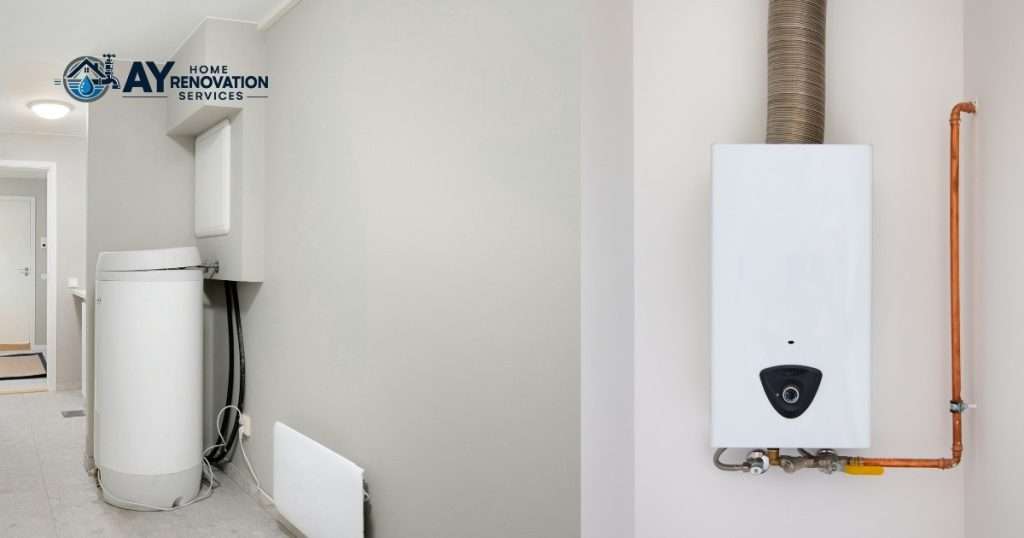
A tank occupies a meaningful footprint of floor. A tankless unit hangs on a wall and is roughly the size of a carry-on suitcase.
In a finished basement, or a house where the mechanical room is doing several jobs at once, that reclaimed space is a genuine benefit and sometimes the deciding factor on its own.
Lifespan
Tankless units generally last longer. A well-maintained tank is often replaced somewhere in the ten-to-fifteen-year range, while tankless units are commonly rated well beyond that.
The word doing the work in that sentence is maintained.
A tankless heater that never gets descaled won’t reach those numbers. Scale in the heat exchanger is the limiting factor, and it accumulates whether you’re paying attention or not. A tank heater that’s flushed yearly and given a new anode rod when it needs one can also considerably outlive its expected span.
Neglect either one and you’ll be replacing it early. The difference is that tank heaters are more forgiving of neglect in the short term.
Running costs
Tankless is more efficient in principle. There’s no reservoir of hot water losing heat to a basement through the night, which is a real and continuous loss on a tank.
How much that’s worth depends on your usage pattern. A household that uses hot water in a few short concentrated bursts benefits most, because the standby loss on a tank is a larger share of total consumption. A household that uses hot water heavily throughout the day sees a smaller relative gain, since the tank isn’t sitting idle as much.
I’d be cautious about any specific savings figure. It depends on your rates, your habits, the age and efficiency of what you’re replacing, and how your house actually uses hot water. The direction is clear; the magnitude is particular to you.
Installation is where the real difference sits
Swapping a tank for a tank is usually a straightforward job. The connections are in place, the venting is sized, the gas line is adequate.
Going from a tank to a tankless unit frequently isn’t, and this is the part that catches people out.
Gas supply. Tankless heaters fire at a much higher input rate than tank heaters, because they’re heating water on demand rather than slowly. Existing gas piping is often undersized for that, and running a larger line, sometimes back to the meter, is real work.
Venting. Tankless units use different venting from an atmospheric tank heater, typically sealed and often requiring a new penetration through an exterior wall. The old chimney or B-vent usually can’t be reused.
Electrical. Even gas tankless units need power for controls, ignition and the fan. That may mean a new circuit.
Condensate. Condensing models produce acidic condensate that needs a drain and often a neutraliser.
Service valves. These make future descaling straightforward. They’re inexpensive at installation and a nuisance to add later. They get left out of quotes surprisingly often, so ask.
None of this is a reason not to go tankless. It is a reason the two quotes will look different, and a reason to be suspicious of any tankless quote that matches a tank swap closely. That usually means something on the list above hasn’t been accounted for. Whoever quotes the water heater installation should be able to walk you through each item.
Which one fits
A tank probably suits you if your hot water demand is predictable and moderate, your current setup works and you’re replacing at end of life, the mechanical room has space, and you’d rather keep the upfront cost and installation complexity down.
Tankless is worth serious consideration if you regularly run out of hot water, you want the floor space back, you’re planning to stay in the house long enough for the efficiency and lifespan to matter, or you’re already opening up the mechanical room for a renovation.
That last one is significant. If gas, venting and electrical are being touched anyway, during a basement finish say, the incremental cost of the tankless requirements is much smaller than doing it as a standalone project.
Be careful with tankless if your house has high simultaneous demand and you’re being offered an entry-level unit, or if nobody has asked you how many fixtures might run at once. Sizing for winter incoming water temperatures is not optional here.
A question worth asking
Whichever way you’re leaning, ask whoever quotes the job to explain their sizing. For a tank, that’s capacity and recovery rate. For a tankless, it’s the flow rate at a realistic winter temperature rise, and how they arrived at it.
A good answer references your actual fixtures and household. A vague one is a reason to get another quote.
If you’re weighing this up for a home in Pickering, Ajax or Whitby, we install and service both, and we’ll tell you honestly when a straight tank replacement is the sensible choice. Have a look at our water heater repair and installation in Pickering, or call 647-248-7755 any hour.