

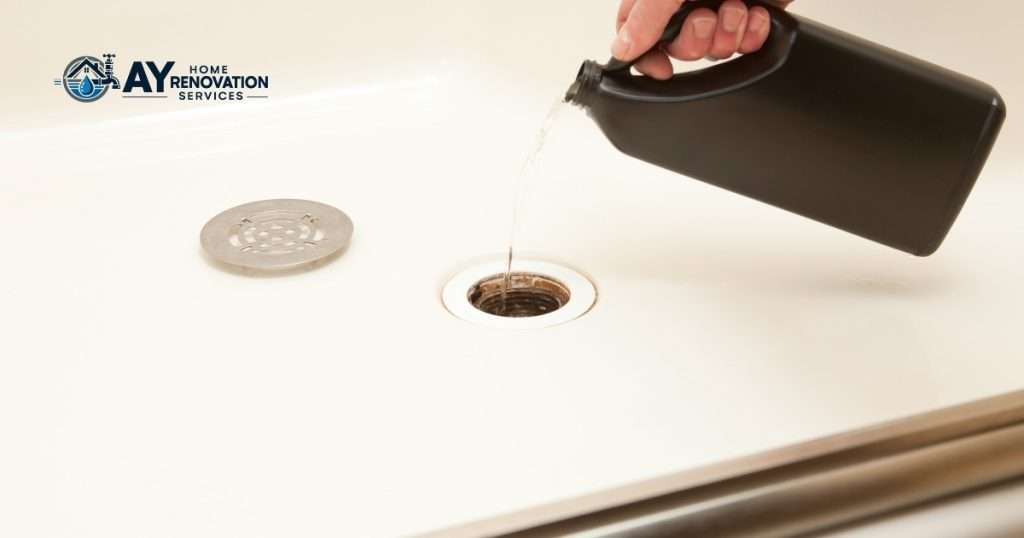
Almost every house has a bottle of drain cleaner under the sink. It is the obvious first move when water stops going down, it costs very little, and often enough it works.
So the honest answer to whether it is safe is not a flat no. It is that these products do a specific job through a fairly aggressive mechanism, and whether that is acceptable depends entirely on what is in your drain, what your pipes are made of, and how many times you have already tried it.
Here is what is actually happening when you pour one in, and where the line sits.
What is in the bottle
Most household drain cleaners fall into one of two groups.
Caustic cleaners are the common ones. They are strongly alkaline, usually sodium hydroxide, sometimes with aluminium particles added. They work by converting fats and grease into a soap-like substance that will dissolve in water, and by breaking down hair and other organic matter.
The aluminium is there deliberately. It reacts with the alkali and generates heat, which speeds everything up. That is why the bottle gets warm and why the instructions tell you not to lean over the drain.
Oxidising cleaners use bleach, peroxides or nitrates. They break organic matter down by oxidation rather than by dissolving it. Generally gentler and generally slower.
There is also a third category sold mainly to trades, acid cleaners, usually sulphuric acid. These are considerably more effective and considerably more dangerous, and they are not something to have in a domestic cupboard.
The heat is the real issue
The thing worth understanding is that these products work by generating heat as well as by chemistry. A caustic cleaner sitting in a blocked pipe can get genuinely hot.
That matters because of what the pipe is made of.
PVC and ABS, which is most drain plumbing in houses built or renovated in the last forty years, soften with heat. A single use is unlikely to do anything. Repeated use, or leaving a product sitting far longer than the instructions say, can distort a joint or weaken the pipe wall. The damage does not announce itself. It shows up later as a leak at a joint inside a wall.
Older metal pipe has a different problem. Cast iron and galvanised steel corrode, and a strongly caustic solution sitting against pipe that is already thinned by decades of use accelerates that. Houses in the older parts of this region often still have original cast iron drain stacks, and those are exactly the pipes least able to take repeated chemical treatment.
Chrome trap fittings and rubber seals under a sink are also in the firing line, and they are the parts most likely to start weeping after heavy use.
Where it genuinely goes wrong
Two situations turn a reasonable first attempt into a real problem.
When the drain is completely blocked rather than slow. This is the important one.
If water is draining slowly, the cleaner travels down to the obstruction, does its work, and gets flushed away.
If the drain is fully blocked, the cleaner sits in a standing column of water above the blockage. It cannot reach anything. It does not drain away. It just sits there, warm, in contact with the pipe wall, for as long as you leave it.
Worse, you now have a pipe full of caustic liquid. If you then reach for a plunger, you are pressurising it. If you open the trap underneath, it comes out onto you. Plumbers are genuinely wary of drains that have had chemicals poured into them for exactly this reason, and it is polite to mention it if someone is coming out.
When it does not work the first time and you try again. Doubling the dose does not double the effect on a blockage the product cannot reach. It doubles the exposure of your pipework.
If one treatment following the instructions has not cleared it, the blockage is not the kind that dissolves. It is a solid object, a root mass, a collapsed section, or a build-up too dense for the chemical to penetrate. Another bottle will not change that.
Where it is reasonable
Being fair to the product, there are situations where reaching for it is a sensible first move.
- A slow bathroom sink or shower drain where the cause is obviously hair and soap, on modern plastic pipework, used once, following the instructions.
- A kitchen sink slowed by grease, again once, on plastic pipe. This is the case caustic cleaners handle best.
- As a first attempt when the alternative is calling someone out for a five minute job.
Used once in a while on a slow drain, in a house with modern plumbing, the risk is low. The problems come from repetition and from using it on the wrong kind of blockage.
What to try first
Most slow drains clear without chemistry at all, and these are worth ten minutes before you open a bottle.
Clear the stopper. For a bathroom sink or shower, most of the hair is within a few centimetres of the opening. Lift or twist out the stopper and pull the mass off it. It is unpleasant and it solves a large share of slow bathroom drains outright.
Boiling water for grease. On a kitchen sink slowed by fat, a kettle of boiling water poured slowly in stages often does the job. Only on metal or on plastic that can take it, and never on a fully blocked drain where it will simply sit.
A plunger, used properly. The trick most people miss is sealing the overflow opening with a wet cloth first. Without that, you are pushing air around in a circle rather than into the pipe.
A drain snake. A basic hand auger is inexpensive and reaches considerably further than anything you can poke down by hand. For hair blockages it is more effective than any chemical, because it pulls the mass out rather than trying to dissolve it in place.
Enzyme cleaners are a different category. They use bacteria to digest organic matter and they are slow, often working overnight, and useless on a full blockage. What they are good at is maintenance, keeping a drain that tends to slow down from getting there. They will not harm pipework.
When to stop
There is a point where continuing to treat it yourself costs more than calling someone.
Stop if the same drain keeps blocking. A drain that clogs repeatedly is not a cleaning problem, it is telling you something about the pipe. We wrote about that pattern separately in why a drain keeps clogging, because the recurring case has different causes from the one-off.
Stop if more than one fixture is affected. One slow sink is a local blockage. A slow sink and a slow bath and a gurgling toilet is a main line problem, and nothing you pour down a sink will reach it.
Stop if it is fully blocked and standing. As above. Chemicals in standing water is the scenario to avoid.
Stop if the drain also smells. A blockage with a persistent smell can point at a venting fault or a partial main line restriction rather than a simple clog. That is covered in why a bathroom smells like sewer.
At that point professional drain cleaning is the better spend, because a snake or a jet clears the blockage physically and, more usefully, whoever does it can tell you what caused it.
The honest summary
Chemical drain cleaner is not the pipe-destroying menace it is sometimes made out to be. Used once on a slow drain in modern plumbing, it is a reasonable thing to try.
It becomes a bad idea when it is used repeatedly, when it is poured into standing water it cannot get through, or when it is used on old metal pipework that is already corroding.
And it never tells you why the drain blocked. That is the real limitation. If a drain has needed clearing twice, the useful question is not which product to buy but what is actually going on in that pipe.
If a drain keeps coming back, more than one fixture is slow, or you would rather not pour anything else down it, we handle drain cleaning across Pickering, Ajax and Whitby. Call 647-248-7755, any hour.