
Kitchen sinks block differently from every other drain in the house, and it is worth knowing why before you start pouring things down one.
A bathroom sink clogs with hair and soap. A kitchen sink clogs with fat. Warm grease goes down the drain as a liquid, travels a short distance, cools against the pipe wall and sets. Then it catches coffee grounds, rice, bits of food and small debris, and the whole thing builds inward like plaque until the opening left is too small.
That difference changes what works. Pulling hair out of a bathroom drain is a mechanical problem. A grease blockage is partly a temperature problem, and the things that work on it are not the same things.
Here is the order worth trying, from least invasive upward.
Start by working out how bad it is
Two questions before anything else.
Is it slow, or is it fully stopped? A slow drain still lets water past, which means anything you put down there travels to the blockage and gets flushed through afterwards. A fully stopped drain holds a column of standing water, and nothing you pour in reaches the obstruction. It just sits in the sink.
Is it only this sink? If the kitchen sink is slow and everything else in the house drains fine, the blockage is local, somewhere between the sink and where that branch joins the main line. If the bathroom is slow too, or a toilet gurgles when the sink drains, the problem is further along and nothing done at the kitchen sink will fix it.
That second check takes thirty seconds and it saves people a lot of wasted effort.
Boiling water, for grease specifically
If the sink is slow rather than stopped, and the likely cause is cooking fat, start here.
Boil a full kettle. Pour it down in stages rather than all at once, giving it fifteen or twenty seconds between pours so the heat has time to work on the deposit rather than rushing past it.
Two limits on this. Do not do it on a fully blocked sink, because you are just adding boiling water to standing water and it will not reach anything. And if your trap and waste pipe are plastic, which most modern ones are, use hot tap water rather than a rolling boil, or boiling water poured slowly rather than dumped. PVC softens with sustained heat and the joints are where it shows.
For a mild grease slowdown this alone clears it surprisingly often.
The plunger, done properly
Most people plunge kitchen sinks wrong, and it is one specific detail.
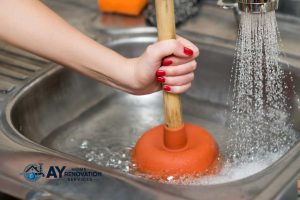
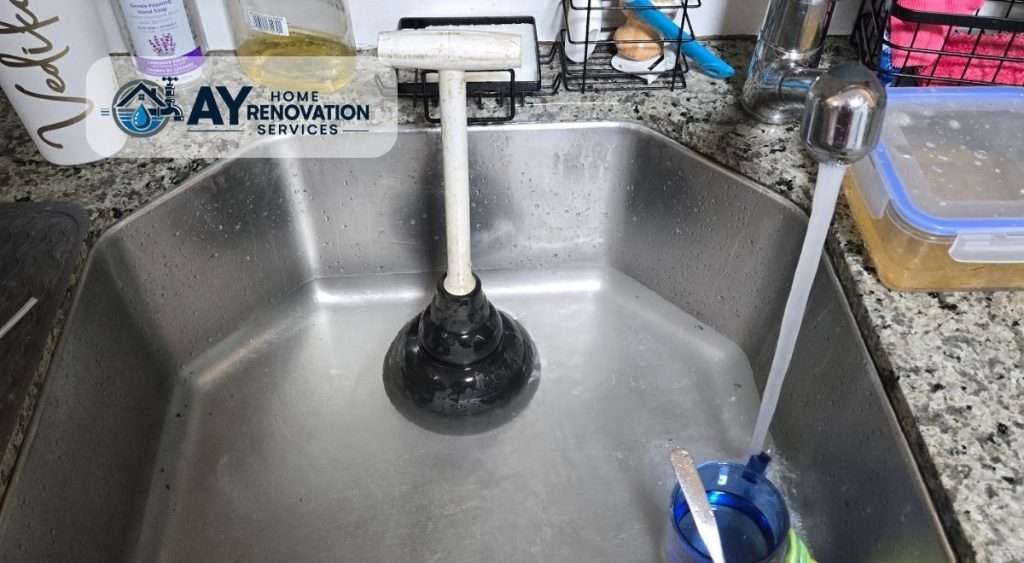
Seal the second opening first. If you have a double sink, the other side needs to be blocked off with a wet cloth pressed down hard or a stopper held in place. If there is an overflow slot, same thing. Without that, the pressure you generate goes straight out the other opening instead of into the blockage. You will plunge for five minutes and achieve nothing, which is exactly what most people experience.
Run enough water to cover the rubber cup, seat it flat over the drain, and push and pull in short strong strokes rather than slow presses. Keep the seal through the whole cycle and break it deliberately at the end.
Fifteen or twenty strokes, then check. If there is any improvement at all, repeat. Partial progress means it is working.
If you have a dishwasher connected, be aware that plunging can push water back up the dishwasher hose. Some installations have a high loop or air gap that prevents this. Not all do.
Cleaning the trap
This is the step people avoid and it is usually the one that actually works, because the U-shaped trap under the sink is where most kitchen blockages sit.
Put a bucket underneath. Not a bowl, a bucket, because there is more water in there than looks possible.
The trap is held on by two large threaded nuts, usually plastic, and usually loose enough to turn by hand. If they need a wrench, go gently, because overtightened plastic nuts crack.
Take the trap off, tip it out, and scrape the inside. What comes out is generally a grey-brown grease deposit with food caught in it, and the sight of it answers the question of what was wrong. Clean the inside properly, check the rubber washers for splits while you have it apart, and refit hand tight.
Test with the bucket still underneath for the first fill. A trap that has been off and refitted is a common place for a slow drip to start, and catching it immediately is easier than finding it later.
If the trap was clear
Then the blockage is downstream, in the horizontal pipe running toward the stack, and that is where a hand auger earns its cost.
A basic drum auger, the kind with a crank handle, is inexpensive and reaches several metres. Feed it into the pipe after removing the trap rather than down through the sink opening, because you get a much straighter run at it and you are not fighting the bend.
Turn the handle as you push, do not force it through resistance. When you hit the blockage you will feel it. Work the cable back and forth, then withdraw it slowly, because on a grease clog you are as often pulling material out as pushing it through.
Then run hot water for a couple of minutes to clear what has been broken loose.
On chemical drain cleaner
It is the first thing most people reach for and it is not the first thing that should be.
On a grease-slowed kitchen sink, used once, following the instructions, on modern plastic pipe, it is defensible. On a fully blocked sink it is a genuinely bad idea, because it sits in standing water in contact with your pipework and makes everything afterwards more hazardous, including for whoever has to open that trap later.
We went through the detail of that in whether chemical drain cleaner is safe for pipes, including what it does to older metal pipe. The short version is that it is a tool with a narrow useful range, and repeat use is where the damage comes from.
Stopping it happening again
Kitchen blockages are the most preventable of any drain problem, because they have one dominant cause.
Do not pour fat down the sink. Not chip fat, not bacon grease, not the oil off a roasting pan. Let it set in the pan and scrape it into the bin, or pour it into a tin and bin it once solid. Running hot water while you pour does not solve it, it just moves the point where it sets further down the pipe, which makes it harder to reach.
Use a sink strainer and empty it into the bin instead of rinsing it through.
Be careful with a garbage disposal if you have one. Coffee grounds, rice, pasta and fibrous vegetable peelings all cause problems regardless of what the unit is rated for, because the issue is not grinding them, it is that they recombine into a paste further down.
Run hot water for thirty seconds after washing up, especially after anything greasy. Cheap habit, genuinely effective.
When it is time to call someone
Some signals mean the DIY route has run out.
- More than one fixture draining slowly, or a toilet that gurgles when the sink empties. That is a main line issue.
- A drain that clears and then blocks again within weeks. Recurrence points at a pipe problem such as a sagging section, a poor fall, or a partially collapsed run, and clearing it repeatedly only treats the symptom.
- Water backing up into the other side of the sink, or into the dishwasher.
- A trap that keeps leaking after refitting, or threads that have cracked.
For blockages that sit beyond the reach of a hand auger, or that keep coming back, professional drain cleaning clears the pipe mechanically and, more usefully, whoever does it can tell you why it is happening. If the problem turns out to be the sink waste, trap or connections themselves rather than the pipe, that is sink repair and installation work instead.
Either way, call 647-248-7755 and describe what the other fixtures in the house are doing, because that is the detail that tells us where the problem actually is.